Introduction to Transformers in Artificial Intelligence
Transformers are one of the most important breakthroughs in modern artificial intelligence. If you’ve ever used tools like chatbots, code assistants, or AI image generators, chances are you’ve already interacted with a Transformer-based model.
But what exactly are Transformers, and why did they change the field of machine learning so dramatically?
In this article, we’ll break down Transformers in a simple and intuitive way—no heavy math required—so you can understand what they are, how they work, and why they matter.
What Is a Transformer?
A Transformer is a type of neural network architecture designed to process sequences of data, such as text, DNA, audio, or time series.
Before Transformers, most sequence models relied on recurrent neural networks (RNNs) or LSTMs, which processed data step by step. This made them slow and difficult to scale.
Transformers introduced a new idea:
👉 process all elements of a sequence in parallel, while still understanding relationships between them.
This single change unlocked massive improvements in speed, scalability, and performance.
Why Are Transformers So Powerful?
Transformers excel because they can:
Understand long-range dependencies in data
Scale efficiently to billions of parameters
Learn rich contextual representations
Run efficiently on GPUs and modern hardware
This is why they are now the backbone of:
Large Language Models (LLMs)
Machine translation systems
Protein structure prediction
Code generation models
Recommendation and search engines
The Core Idea: Attention
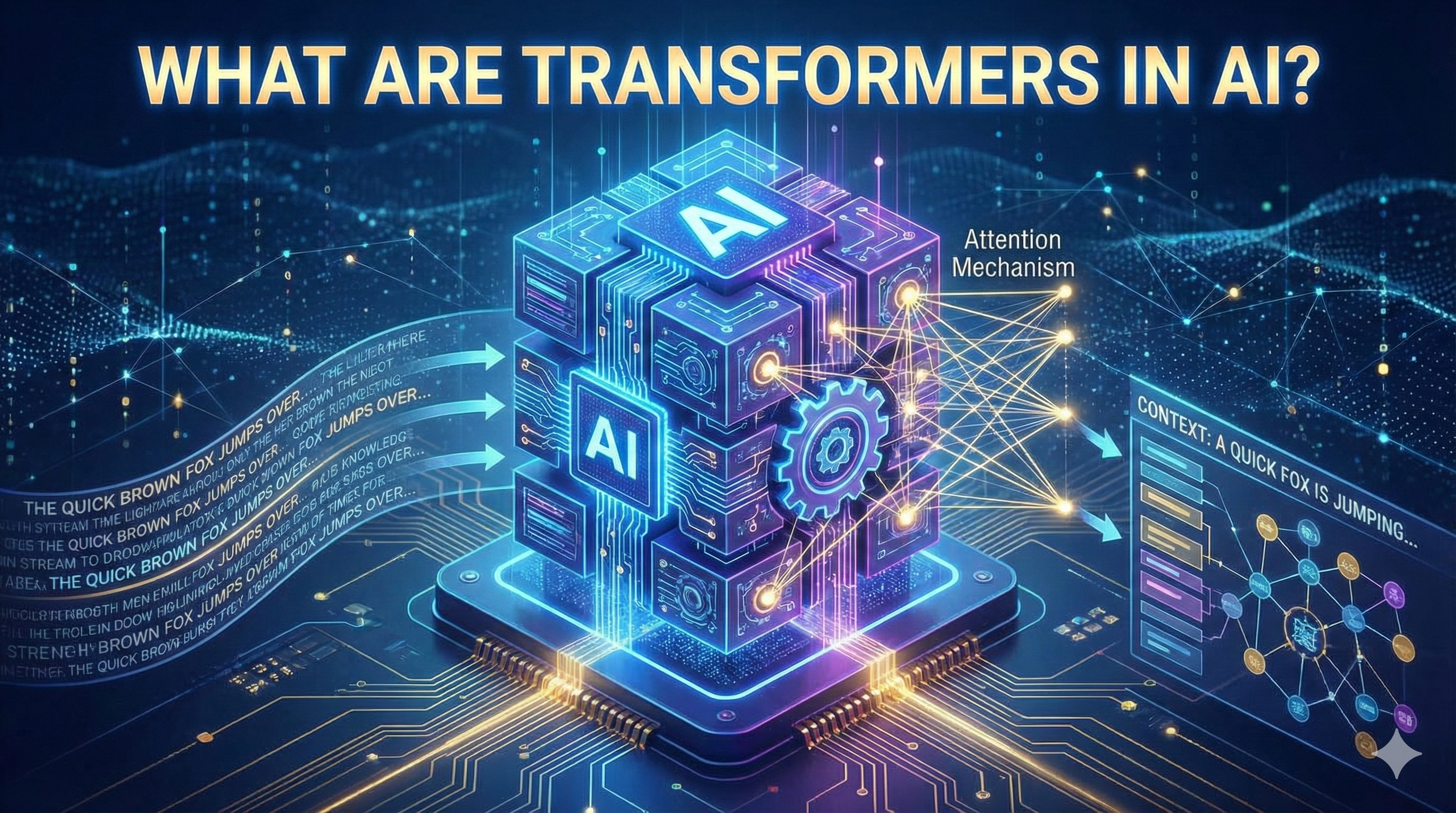
At the heart of Transformers lies a mechanism called self-attention.
Self-attention allows the model to answer questions like:
Which words in this sentence are most relevant to each other?
Which parts of the input should I focus on right now?
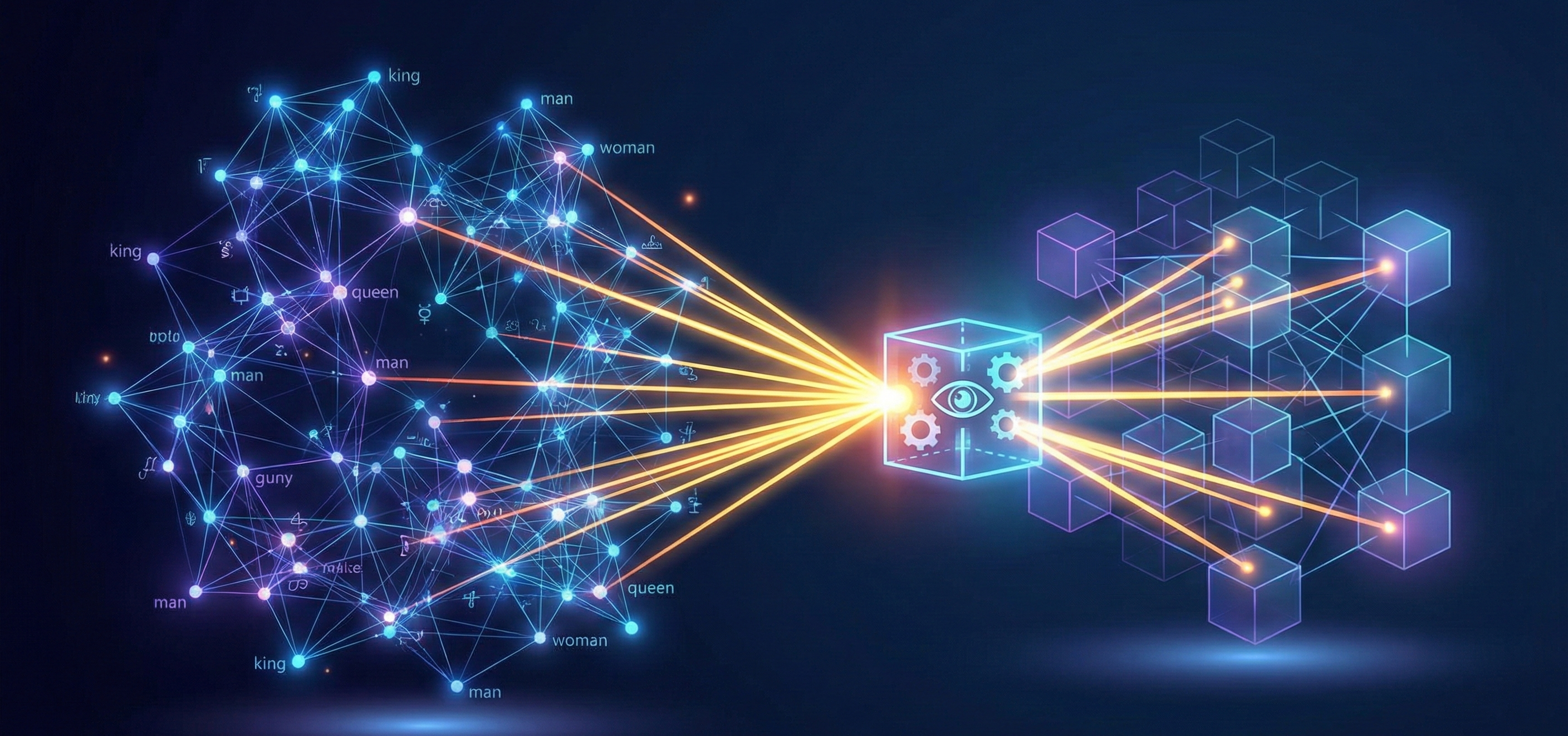
Instead of reading a sentence word by word, the Transformer looks at all words at once and computes how strongly each word relates to every other word.
This makes context handling far more flexible and powerful than older architectures.
Key Components of a Transformer
A standard Transformer block is built from a few repeating parts:
1. Token Embeddings
Raw inputs (like words or symbols) are converted into numerical vectors that the model can work with.
2. Self-Attention Layer
Each token attends to all others, weighting them by relevance.
3. Feed-Forward Network (MLP)
A small neural network applied independently to each token to increase expressive power.
4. Residual Connections
Shortcut paths that help gradients flow smoothly during training.
5. Layer Normalization
Keeps training stable and well-behaved, even in very deep networks.
By stacking many of these blocks, Transformers build deep representations of complex data.
Encoder, Decoder, or Both?
Transformers come in different flavors depending on the task:
Encoder-only models: focus on understanding input (e.g. classification, embeddings)
Decoder-only models: focus on generating sequences (e.g. text generation)
Encoder–Decoder models: transform one sequence into another (e.g. translation)
This flexibility is one reason Transformers are so widely adopted.
Why Transformers Replaced RNNs
Compared to older sequence models, Transformers offer:
Parallel processing instead of sequential steps
Better handling of long contexts
Easier training at large scale
Superior performance across tasks
In practice, this means faster training, better results, and the ability to build truly large models.
Transformers Beyond Text
Although they became famous through language models, Transformers are now used in many fields:
Computer vision (images and video)
Speech recognition
Biology and protein modeling
Time-series forecasting
Reinforcement learning
Anywhere data has structure and relationships, Transformers tend to shine.
Final Thoughts
Transformers are not just another neural network architecture—they represent a shift in how machines process information.
By replacing recurrence with attention and parallelism, they unlocked the modern era of large-scale AI.
If you’re learning machine learning, AI, or data science today, understanding Transformers is no longer optional—it’s foundational.